
HOW TO PLAY
Everything below is running the real engine. The notes fall, get judged and score exactly as they do in a run, because these demos use the same simulation the game and the server do. Watch one loop of each and you know the whole game.
The one decision
You are not trying to score. You are trying to choose when to stop circulating.
Charge, multiplier, bank $
Catching notes fills charge. Charge is worth nothing if the run ends while you are holding it.
Every six consecutive catches adds ×1, up to ×8. A single tear puts you back to ×1.
Banking pays charge × multiplier into your score, then resets the multiplier. Safe, and expensive.
Five tears ends the run and burns every point of unbanked charge with it.
The controls
Four lanes, one key each. A fifth lane opens later. On a phone, tap the pads under the field.
Arrow keys work too. Pressing a lane with nothing in it breaks your combo but costs no integrity, so a mistimed tap is survivable. Holding a key does nothing unless the note has a tail.
What falls
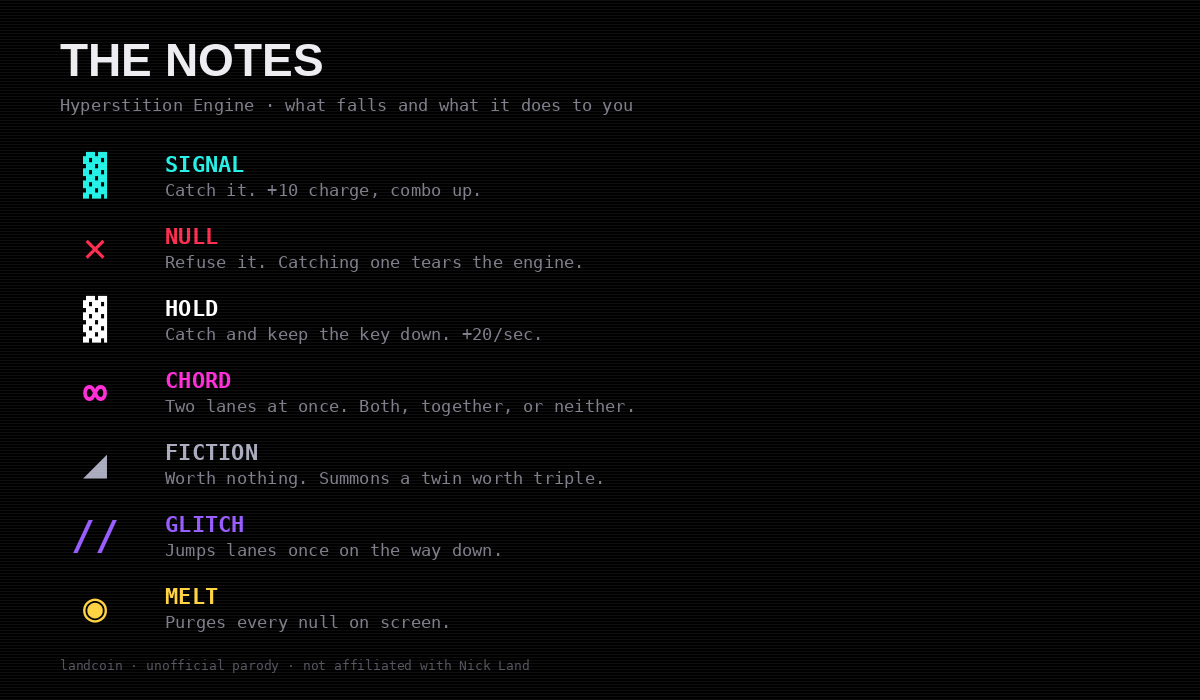
Seven kinds of note. Three of them are not what they look like.
Signal ▓ ◢ ∞ //
Null ✕
Hold ▓▔
Chord ▓ ▓
Fiction, and its twin ◢ → ∞
Glitch //
Melt ◉
The fiction, in one line ∞
A fiction pays nothing and is safe to ignore. Catch it and it schedules a twin worth triple — but the twin is a real signal, so missing it tears you. Making a fiction real is a debt you take on deliberately.
The zones
Banked score moves the run through five zones. Each one changes a rule, and you do not get to go back.
| Cryogenic 0 | Four lanes on the beat. The tempo starts at 90 BPM and climbs. |
|---|---|
| Meltdown 400 | Catching a null now costs two integrity instead of one. |
| Templexity 2,000 | Every twenty seconds, for five seconds, gravity reverses and notes rise from the bottom. |
| Escape Velocity 5,000 | A fifth lane opens on G and the tempo ceiling rises to 184 BPM. |
| The Outside 12,000 | The intake line disappears, notes fade before they land, and the hit window halves. You are playing on rhythm alone. |
The fragments
Every zone boundary stops time and offers three. You take one, and it holds for the rest of the run. On the daily seed everyone is offered the same three, so the choice is the only thing that separates you.
| § Capital is an intelligence | Multiplier cap rises from ×8 to ×12. The greedy pick, and the correct one if your hands are steady. |
|---|---|
| § Nothing human makes it out | Nulls become half as common, but each one costs three integrity. Fewer traps, deadlier traps. |
| § Templexity | Banking keeps your combo, but unbanked charge decays 2% per second. Turns banking from a sacrifice into a habit. |
| § Meat-space | Two integrity now, one lane closed forever. Buys time and takes away room. |
| § Hyperstition | Fiction notes appear twice as often. More triple-value twins, more debts to honour. |
| § The Outside | Every bank pays double. Integrity drops to one and cannot rise. The run becomes a knife-edge and the payouts get very large. |
How to stop being bad at it
Measured against the engine itself: everyone who banks scores something, and every average player who hoards scores nothing at all.
The most common way to end a run with zero is to be holding a beautiful multiplier when the fifth tear lands. Bank at ×4 until banking stops feeling like a loss.
Letting a null through is free. The only reason to touch one is panic. Keep your hands still when you are not sure.
Notes land on the beat. Once the tempo is in your ear you will catch things you did not consciously see, which is the only way to survive The Outside.
A fiction is a promise to catch something harder later. At one or two integrity, do not make promises.
On the daily run the leader plays beside you. When their banked score jumps and yours has not, you waited too long.
Duels are not won on score. First meltdown loses. Bank constantly, take no risks, and let their greed do the work.